MegaETH processes transactions at 1,700 MGas/s—a 65-fold leap over the 26 MGas/s peak of leading Layer 2 networks like Base—while compiling blocks every 10 milliseconds. Positioned as the industry’s first “real-time blockchain,” it targets sustained throughput exceeding 100,000 transactions per second (TPS), closing the latency gap between decentralized rollups and centralized Web2 databases. Yet this performance rests on a single active sequencer running on enterprise hardware, a deliberate trade-off that swaps sequencing-layer decentralization for raw speed.
What’s happening: MegaETH launched its public mainnet on February 9, 2026, followed by the Token Generation Event (TGE) for its native MEGA token on April 30, 2026. Built as an EVM-compatible Layer 2 on the OP Stack, the network decouples block execution from block verification—routing all transactions through one high-performance sequencer while delegating settlement and data availability to Ethereum Layer 1 and EigenDA. Within weeks of launch, Total Value Locked (TVL) climbed from $89 million to nearly $800 million, surpassing rival EVM-scaling Layer 1 Monad.
Why it matters: Early rollups solved Ethereum’s fee problem but never delivered the microsecond-level responsiveness that real-time consumer applications—on-chain games, high-frequency trading, social layers—actually require. MegaETH’s heterogeneous node architecture demonstrates that an EVM chain can approach the performance profile of a centralized server while inheriting Ethereum’s security guarantees. The design reframes the scaling debate: the bottleneck is no longer consensus, but the execution and state-storage stack itself.
When and where: The rollout followed a disciplined sequence. A seven-day Global Stress Test began January 22, 2026, processing 10.3 billion transactions before mainnet. The “Frontier” launch phase used a curated genesis cohort of partner applications. The first tokenomics milestone triggered on April 23, 2026, initiating a seven-day countdown to TGE. MEGA now trades across 13 centralized exchanges, including Binance and Coinbase.
Who and how: MegaLabs, the development entity, raised over $108 million from backers including Ethereum co-founders Vitalik Buterin and Joseph Lubin, Dragonfly Capital, and EigenLayer founder Sreeram Kannan. The founding team’s distributed-systems pedigree—Stanford and MIT doctorates in low-latency datacenter computing—directly shaped the architecture.
This comprehensive analysis examines MegaETH’s origin and leadership, its specialized node topology, the execution and database optimizations behind its throughput, operational stress-test results, the MEGA tokenomics framework, ecosystem integrations, comparative positioning against Monad and Solana, and a critical assessment of its structural risks.
Origin, Vision, and Leadership
MegaETH was conceived to address the fundamental processing limits of standard EVM clients, with a design philosophy rooted in low-latency datacenter computing and enterprise-scale business development. The leadership team blends deep academic research with commercial experience at the heart of the Ethereum ecosystem.
- Yilong Li (Co-Founder & CEO) holds a Ph.D. in Computer Science from Stanford, where he researched microsecond-scale distributed systems in John Ousterhout’s Platform Lab. He previously worked as a senior engineer at formal-verification firm Runtime Verification.
- Lei Yang (Co-Founder & CTO) completed his Ph.D. at MIT in 2024 and co-authored “DispersedLedger: High-Throughput Byzantine Consensus on Variable Bandwidth Networks” (NSDI 2022) alongside EigenLayer founder Sreeram Kannan and Stanford professor David Tse.
- Shuyao Kong (Co-Founder & CBO) spent over six years at ConsenSys as Global Head of Business Development, following roles at Brave Software, IBM, and Infosys.
- Namik Muduroglu (CSO) previously led strategic business development at ConsenSys, invested at Hypersphere Ventures, and co-founded the open-source identity nonprofit humanID.
MegaLabs secured over $108 million across multiple funding rounds. Beyond Buterin and Lubin, backers include Dragonfly Capital, Robot Ventures, Figment Capital, and angel investors Sreeram Kannan (EigenLayer) and Kain Warwick (Synthetix)—a roster that signals strong alignment with core Ethereum research.
Technical Architecture: Specialized Node Topology
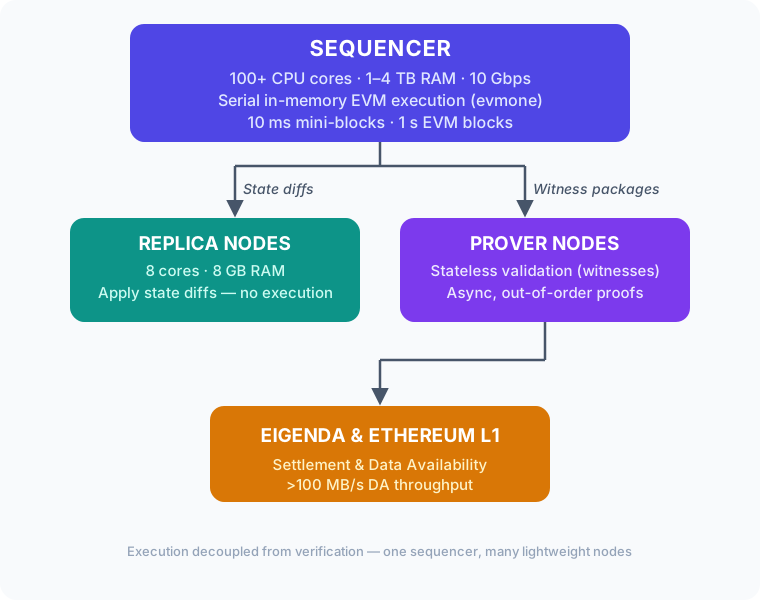
Monolithic blockchains cap throughput by forcing every validator to execute every transaction, order blocks, reach consensus, and maintain the full historical state. MegaETH breaks this bottleneck with a heterogeneous node architecture that assigns specialized roles based on hardware capability.
The Sequencer
The sequencer is the network’s central execution engine. To eliminate consensus round-trips during real-time processing, MegaETH routes all transactions through a single active sequencer at any given moment. It runs on high-end server hardware—over 100 CPU cores, 1TB to 4TB of RAM, and a 10 Gbps connection—holding the entire active network state in memory to remove disk read/write latency from the execution path.
The sequencer produces two block types to balance user experience against tooling compatibility:
- Mini-Blocks: generated every 10 milliseconds, carrying real-time transaction ordering and execution for near-instant soft confirmations.
- Standard EVM Blocks: compiled every 1 second, grouping mini-blocks to remain compatible with conventional Web3 wallets, block explorers, and RPC infrastructure.
Replica and Prover Nodes
Replica nodes maintain an up-to-date copy of the chain state without executing smart contracts. They receive compressed state differences streamed from the sequencer and apply them directly to local databases, dropping hardware requirements to just 8 CPU cores and 8GB of RAM.
Prover nodes generate cryptographic proofs of block correctness asynchronously and out of order, decoupling verification from execution so that proving delays never throttle transaction speed. Using stateless validation, they verify correctness with compact proofs called witnesses rather than holding the full chain state—allowing nodes with as little as 2 CPU cores and 1GB of RAM to validate execution. A dual-client model developed with Pi Squared has two independent systems verify every block, accepting it on-chain only when both agree, reducing the risk of client-specific implementation bugs.
Full nodes remain traditional verification instances that re-execute every transaction from scratch. These are run by high-trust participants—cross-chain bridges, DEX routers, and institutional market makers—who require independent confirmation of finality.
Performance Execution and Database Optimizations
Reaching 1,700 MGas/s—roughly 65 times the 26 MGas/s peak of standard Layer 2 networks like Base—demands optimization across the entire execution and storage stack, not a single silver bullet.
| Optimization Layer | Technology | Primary Mechanism | Performance Impact |
|---|---|---|---|
| Execution Engine | JIT-compiled evmone | Compiles EVM bytecode to native machine code on the fly | Closes the gap between EVM bytecode and native runtimes |
| Database Structure | New Optimized Merkle Trie (NOMT) | Minimizes write amplification and random disk I/O | Cuts state-root update costs by up to 90% |
| Network Sync | State diff compression | Broadcasts only byte-level state changes | Enables 100,000 TPS sync within standard bandwidth |
| Data Availability | EigenDA integration | Scalable DA layer built on EigenLayer | Supports throughput exceeding 100 MB/s |
| Contract Limits | Expanded EVM parameters | Raises contract size to 512 KB, tx limit to 1B gas | Unlocks complex, monolithic contract deployment |
The JIT-Compiled evmone Client
Traditional EVM execution is bottlenecked by the interpreter loop in standard Go-Ethereum (Geth) clients. MegaETH replaces it with evmone, an optimized C++ implementation, then layers a Just-In-Time (JIT) compiler on top to translate heavily-used bytecode directly into native machine code during execution—removing interpreter overhead and pushing execution toward bare-metal speed.
New Optimized Merkle Trie (NOMT)
State-root updates are a major database bottleneck. MegaETH’s research found that updating the Merkle Patricia Trie in modern clients like Reth can consume up to ten times more compute than executing the transactions themselves. NOMT counters this with batch processing and structured database layouts that minimize random disk I/O, letting state-root updates keep pace with 10ms block times.
State Diff Compression
At high throughput, state synchronization becomes a bandwidth problem—synchronizing 100,000 basic ERC-20 transfers per second requires roughly 152.6 Mbps of constant bandwidth. Rather than broadcasting full transaction inputs, the sequencer compresses and streams only the byte-level state changes, letting replica nodes sync with the sequencer without enterprise-grade network connections.
Data Availability via EigenDA
To prevent data availability from capping execution speed, MegaETH integrates EigenDA, a specialized DA layer built on EigenLayer that supports throughput exceeding 100 MB/s. This keeps block data, witnesses, and state diffs accessible to verification nodes even if the sequencer experiences downtime or attempts data withholding.
Operational Milestones and Stress Testing
MegaETH’s deployment path emphasized production-readiness over hype, marked by both a public setback and a large-scale stress demonstration.
Pre-Deposit Setback
In November 2025, MegaETH opened a pre-deposit campaign for its yield-bearing stablecoin USDm, hitting its cap with $250 million in deposits. Technical coordination issues within the multi-signature contract structure caused operational disruptions. In response, MegaLabs returned 100% of deposited funds to users—prioritizing institutional trust at the cost of temporarily delaying ecosystem liquidity.
The Global Stress Test
A seven-day Global Stress Test began January 22, 2026 to prove production readiness ahead of mainnet:
- Target: 11 billion transactions over 7 consecutive days at a sustained 15,000–35,000 TPS under mixed asset transfers and Uniswap v3-style swaps.
- Result: the network processed 10.3 billion transactions, with sustained throughput holding between 10,000 and 22,000 TPS and peaking at 47,000 TPS.
- Infrastructure impact: sustained execution of 1,700 MGas/s versus Base’s 26 MGas/s peak. The 10ms block rate forced reliance on real-time indexing interfaces, as traditional block explorers struggled to keep up.
Following the test, the public mainnet went live February 9, 2026 via a curated “Frontier” phase, using a genesis cohort of partner applications to monitor stability before opening public contract deployment.
The MEGA Tokenomics Framework
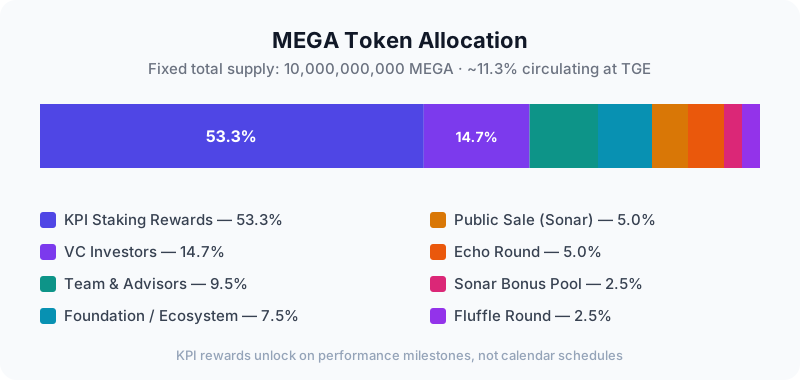
MEGA, the network’s utility and governance token, launched via TGE on April 30, 2026 with a fixed total supply of 10 billion tokens. Approximately 1.13 billion (11.3%) entered circulation at TGE.
Allocation and Vesting
| Allocation | Share | Vesting Mechanism |
|---|---|---|
| KPI Staking Rewards | 53.3% | Released on performance milestones, not calendar schedules |
| VC Investors | 14.7% | Standard cliffs + linear unlocks |
| Team & Advisors | 9.5% | Multi-year vesting agreements |
| Foundation / Ecosystem | 7.5% | Grants, marketing, core infrastructure |
| Public Sale (Sonar) | 5.0% | Immediate unlock or discounted locked option |
| Echo Round | 5.0% | 20% at TGE, 1-year cliff, 3-year linear |
| Sonar Bonus Pool | 2.5% | Incentive bonuses for public-sale participants |
| Fluffle Round | 2.5% | 50% at TGE, remainder linear over 6 months |
KPI-Based Vesting and the TGE Trigger
To mitigate sudden dilution, MegaETH gates more than half its supply (53.3%) behind KPI Staking Rewards, released only when the network hits verifiable, performance-based milestones:
- Ecosystem Growth: measured by network TVL and circulating supply of the USDm stablecoin.
- Network Decentralization: evaluated against Vitalik Buterin’s standardized L2 staging model toward multi-prover validation.
- Raw Performance Benchmarks: verified processing speed, throughput, and block gas capacity.
- Ethereum Alignment: financial and technical contributions to the Ethereum validator set and client diversity.
The first KPI trigger was met on April 23, 2026, when 10 applications from the “Mega Mafia” accelerator each surpassed 100,000 transactions within a 30-day window, initiating the seven-day countdown to TGE. The qualifying cohort spans payments (Cap), RWA yield tokenization (Brix), lending (Avon), the primary DEX/AMM router (Kumbaya), decentralized telecom (Ubitel), real-time gaming (Showdown, Stomp), a consumer social layer (World), retail brokerage (HitOne), and an AI consumer app (Nectar AI).
Other targets remain untriggered, including a $500 million circulating USDm supply (it stood at just $62.9 million at TGE) and three mainnet applications each generating $50,000 in daily fees for 30 consecutive days—a reminder that much of the supply is still contingent on real adoption.
Early Token Market Performance
MEGA began trading on 13 centralized exchanges, with traders accessing it through leading global exchanges such as Binance and Coinbase:
| Metric | Value | Context |
|---|---|---|
| Pre-market implied FDV | up to $6 billion | Hyperliquid perpetuals ahead of launch |
| Launch-day open | ~$0.22 | Fully diluted valuation of $2.2 billion |
| 72-hour adjustment | -38% | Early-unlock selling pressure |
| Mid-May spot range | $0.06–$0.15 | FDV compressed to $700M–$1.5B |
| TVL growth | $89M → ~$800M | Driven by Aave v3, GMX, Algebra |
Notably, TVL grew even as the token price fell—institutional deployments on Aave v3 held the majority of early deposits, signaling that capital was attracted by the infrastructure rather than purely by token speculation.
The Native Token Economic Loop
MEGA’s utility is structured around three reinforcing mechanisms:
- Staking for Sequencer Rotation: because the network uses a rotating single-sequencer model, operators must stake MEGA to compete for active execution windows, with selection weighted by stake size, historical performance, and hardware uptime.
- Proximity Markets: market makers and latency-sensitive dApps lock MEGA to bid on “colocation” slots, running infrastructure near the sequencer to minimize round-trip delay—a native, structured path for capturing Miner Extractable Value (MEV).
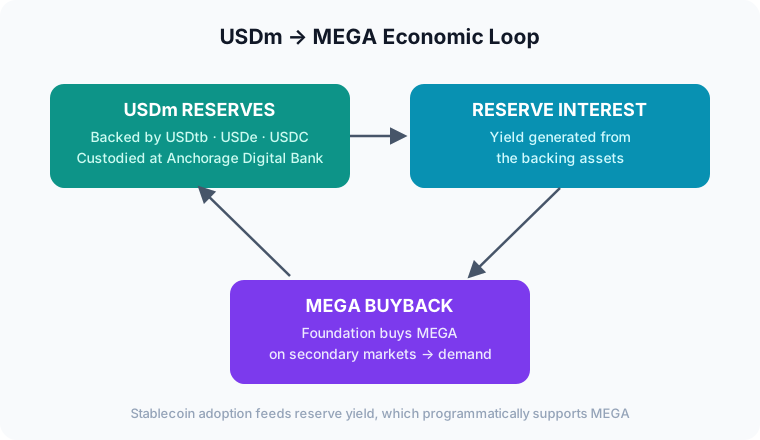
- Economic Support from USDm: the Foundation uses interest revenue from USDm’s reserves to execute programmatic MEGA buybacks on secondary markets, linking stablecoin adoption directly to token demand.
Ecosystem Integrations and Stablecoin Architecture
MegaETH’s integration strategy centers on capital-efficient financial markets and high-performance trading infrastructure that can actually exploit 10ms blocks.
The Native USDm Stablecoin
Developed with Ethena, USDm is the ecosystem’s primary stablecoin, backed by USDtb (issued by Anchorage Digital Bank), Ethena’s USDe, and USDC. Circulating supply grew from $62.9 million to over $300 million by May 2026. Reserve interest funds the MEGA buyback engine, forming a closed economic loop:
Trading and DeFi Infrastructure
- iTRY: a Turkish Lira stablecoin backed by institutional money-market funds, paired with an on-chain yield-looping engine offering real-time APY up to 45%—a test case for automated, high-velocity arbitrage on a real-time client.
- GMX: selected MegaETH for its perpetual exchange expansion, running high-leverage BTC, ETH, and SOL markets backed by a single-sided GMX Liquidity Vault using USDm. The 10ms block time lets GMX quote and execute with minimal slippage, approaching centralized-exchange latency.
- Algebra: integrated its concentrated-liquidity AMM, exploiting sub-10ms blocks so market makers can adjust liquidity ranges during volatile moves without block-space congestion.
- Chainlink CCIP & Data Streams: provide sub-second oracle price feeds and secure cross-chain transfers for the ecosystem’s DeFi protocols.
Comparative Scalability Paradigms
MegaETH, Monad, and Solana represent three distinct strategies for high-performance execution.
| Vector | MegaETH (L2) | Monad (L1) | Solana (L1) |
|---|---|---|---|
| Trust Model | Settles to Ethereum L1 | Sovereign L1 consensus | Sovereign L1 consensus |
| Throughput (TPS) | 100,000+ (target) | 10,000 (sustained) | 1,300–3,000 (sustained) |
| Block Time | 10ms (mini-blocks) | 400ms–1s | 400ms |
| Execution Style | Serial, in-memory | Optimistic parallel | Parallel, local state DB |
| Database | NOMT state trie | MonadDB custom engine | Flat database structures |
| Hardware Cost | High-end server (sequencer only) | Mid-range validator | Specialized validator |
| EVM Equivalence | Full EVM equivalence | EVM bytecode compatible | Non-EVM (native SVM) |
The Monad vs. MegaETH Debate
Monad and MegaETH attack EVM scaling from opposite directions. Monad is a standalone Layer 1 that optimizes the EVM through optimistic parallel execution and a custom database engine (MonadDB), preserving decentralized consensus across 200+ validators on relatively accessible hardware. MegaETH, by contrast, is an Ethereum Layer 2 that prioritizes speed and low latency by executing serially in-memory—delegating security to Ethereum L1 so its sequencer can run on high-performance hardware without compromising core safety.
The capital outcomes diverged accordingly. Monad’s TVL reached roughly $335 million by May 2026 with native Uniswap and Curve deployments. MegaETH climbed past $796 million by mid-May 2026, surpassing Monad—but with higher concentration, as a significant share of deposits sat in Kumbaya XYZ ($51 million of early organic TVL) and Aave v3. For investors weighing where capital is most resilient, that concentration is a meaningful signal. This dynamic echoes the trade-offs explored in our in-depth Arbitrum Layer 2 scaling analysis, where security inheritance and decentralization shape long-term adoption.
Critical Risk Assessment
Despite its performance metrics and capitalization, MegaETH carries several structural risks that temper the headline numbers.
Sequencer centralization and censorship. The single active sequencer is a potential single point of failure. If it goes offline, L2 execution pauses until a backup is online. Users can withdraw via Ethereum L1 “escape hatches” in a censorship scenario, but a sequencer outage would still disrupt real-time dApps. Transitioning to a decentralized, multi-sequencer rotation remains the project’s defining long-term milestone.
Data availability cost scaling. At high throughput, MegaETH is heavily dependent on EigenDA capacity. Network congestion or fee volatility on the DA layer would raise the cost of posting data back to Ethereum L1—directly increasing end-user transaction costs and challenging the low-fee model.
Hardware barriers to decentralization. Sequencer hardware requirements confine execution to enterprise-grade datacenters, shrinking the operator pool. While replica nodes run on consumer devices, the high cost of sequencer hardware risks operational centralization within a small group of institutional infrastructure providers.
Because the network optimizes for latency rather than distributing execution across many validators, secure self-custody of MEGA and ecosystem assets matters more, not less. Investors holding meaningful positions should pair on-chain activity with offline storage via a hardware cold wallet to insulate keys from the smart-contract and exchange risks inherent to any high-velocity DeFi environment.
Conclusion: Speed Traded for Sovereignty
MegaETH is a high-performance Layer 2 that deliberately trades sequencing-layer decentralization for low latency and high computational throughput. Through a specialized node topology, in-memory serial execution, JIT compilation, and the NOMT state trie, it achieves block times and processing speeds that approach centralized Web2 databases while settling to Ethereum L1.
Three takeaways define its first months in production. First, the architecture works—the Global Stress Test cleared 10.3 billion transactions at a sustained 1,700 MGas/s, validating the execution model. Second, capital follows infrastructure, with TVL surpassing $796 million and overtaking Monad even as the MEGA token corrected 38% post-launch. Third, the risks are concentrated, not eliminated—the single sequencer, EigenDA dependency, and enterprise hardware requirements all hinge on a future decentralization roadmap that has yet to be delivered.
For builders, MegaETH unlocks application categories that previous EVM chains could not support: real-time games, latency-sensitive perpetual markets, and consumer social layers. For investors and analysts, the central question for 2026 is execution risk of a different kind—whether the team can decentralize its sequencer network and hold data availability costs stable as transaction volumes scale. The performance ceiling is proven; the durability of the model is not yet.
Learn More
For traders evaluating exposure to emerging Layer 2 ecosystems, our crypto exchange comparison guide breaks down liquidity, fees, and access across leading platforms. To understand how DeFi money markets like Aave anchor TVL on new chains, see our Aave protocol deep-dive analysis.
Key Sources
This analysis synthesizes technical documentation, market data, and protocol research, including:
- Ethereum Foundation — Layer 2 scaling overview
- L2BEAT — Rollup Stages framework
- EigenLayer / EigenDA — data availability layer
- evmone — optimized C++ EVM implementation
- Yang et al., “DispersedLedger” (USENIX NSDI 2022)
- Ethena — USDe synthetic dollar
- Chainlink — CCIP cross-chain interoperability
Disclaimer: This analysis is provided for educational and informational purposes only. It does not constitute financial, investment, tax, or legal advice. Cryptocurrency and emerging blockchain assets carry substantial risk, including the potential loss of principal, and early-stage networks face heightened technical and liquidity uncertainty. Token prices, valuations, and ecosystem metrics referenced reflect specific dates and can change rapidly. Always conduct your own due diligence and consult licensed professionals before making investment decisions.