Somnia targets a theoretical ceiling exceeding 1,000,000 transactions per second (TPS) while maintaining full Ethereum Virtual Machine (EVM) compatibility—paired with a custom storage engine, IceDB, that delivers 15-to-100 nanosecond read/write latency. Beyond raw performance, the network introduces a category-defining capability: deterministic on-chain Large Language Models running natively inside the validator set. Backed by $270 million in committed capital and the 13-year distributed-systems heritage of Improbable, Somnia reframes the high-performance L1 conversation around real-time consumer applications rather than financial primitives alone.
What’s happening: Somnia launched its public mainnet on September 2, 2025, after years of incubation through Improbable and its metaverse subsidiary MSquared. The native SOMI token entered circulation at approximately 16.02% of the 1 billion fixed supply, with subsequent integrations including the native USDso stablecoin (May 5, 2026) and LI.FI cross-chain routing across 60+ networks (May 25, 2026). The architecture rebuilds three layers simultaneously: a MultiStream BFT consensus, compiled EVM bytecode, and the bespoke IceDB state engine.
Why it matters: Existing high-performance chains optimize a single metric—Solana parallelizes execution, Monad rewrites the database, Sui restructures the state model. Somnia’s full-stack redesign attacks consensus, execution, and storage in parallel, then layers a genuinely novel primitive on top: Somnia Agents, decentralized compute containers capable of running deterministic LLM inference with cryptographic audit receipts. For developers building real-time games, autonomous agents, and reactive DeFi, this combination unlocks application patterns that no other EVM-compatible chain supports natively today.
When and where: Mainnet launched September 2, 2025; USDso went live May 5, 2026; LI.FI integration shipped May 25, 2026. SOMI now trades across major centralized exchanges—Binance, HTX, Bybit, Bithumb, Upbit, BitMart, SuperEx—with Coinbase adding SOMI perpetual contracts in October 2025. The current price hovers near $0.172 as of May 2026, having retraced from a launch peak of $1.84.
Who and how: Somnia is operated by the Virtual Society Foundation (VSF), an independent non-profit spun out of Improbable and MSquared. The leadership team blends Web3, gaming, and AI backgrounds—CEO Paul Thomas (crypto/gaming/metaverse veteran), Head of Engineering Ignacio (former AI programmer), and senior contributors from Improbable’s 13-year history in distributed simulations. MSquared raised $150 million at a $1 billion valuation in April 2022 from Andreessen Horowitz (a16z) and SoftBank Vision Fund 2, and the broader treasury reaches $270 million when combined with Improbable and VSF capital.
This analysis examines Somnia’s origin and leadership, dissects its MultiStream + IceDB architecture, evaluates the Agentic L1 primitive and on-chain LLM execution model, breaks down SOMI tokenomics and gas pricing mechanics, surveys the ecosystem of flagship games and grant programs, and weighs market performance against the structural risks of validator centralization and L1 competition.
Origins, Founding Team, and Strategic Alignment
The Somnia Network was launched in 2024 by the Virtual Society Foundation (VSF), an independent non-profit initiated by Improbable—a British technology company with deep credentials in distributed systems and large-scale simulations—and its interoperable metaverse project MSquared. The structural separation matters: VSF operates the blockchain protocol independently from Improbable’s commercial divisions, preserving decentralization and neutrality at the foundation layer.
MSquared itself was established by Improbable in April 2022 with $150 million raised at a $1 billion valuation from Andreessen Horowitz (a16z) and SoftBank Vision Fund 2. The thesis behind spinning out VSF was that the infrastructure required for a “unified virtual society”—shared real-time worlds, interoperable assets, on-chain agents—could not be built on existing general-purpose chains. The team needed control over consensus, execution, and storage simultaneously.
Operational execution sits with a cross-disciplinary leadership group:
- Paul Thomas — Founder & CEO, with extensive experience in cryptocurrency, gaming, and the metaverse.
- Michelle — CMO, leading global marketing from Seoul and New Jersey.
- Ignacio — Head of Engineering, formerly an AI programmer who transitioned to blockchain systems.
- Sam Snyder — SVP of R&D.
- Daigan Reid — Head of Community.
- Wen Loong Lau — Business Development Lead.
This interdisciplinary bench—AI, gaming, distributed systems, business development—is what allows Somnia to coordinate infrastructure design with consumer product adoption, rather than treating the blockchain as a generic execution layer waiting for applications to find it.
Technical Architecture: MultiStream, IceDB, and Compiled Bytecode
Whereas most high-performance blockchains optimize a single metric, Somnia executes a full-stack architectural redesign—rebuilding consensus, execution, and storage simultaneously to unlock CPU potential and bypass conventional hardware bottlenecks.
MultiStream Consensus and Data Chain Structure
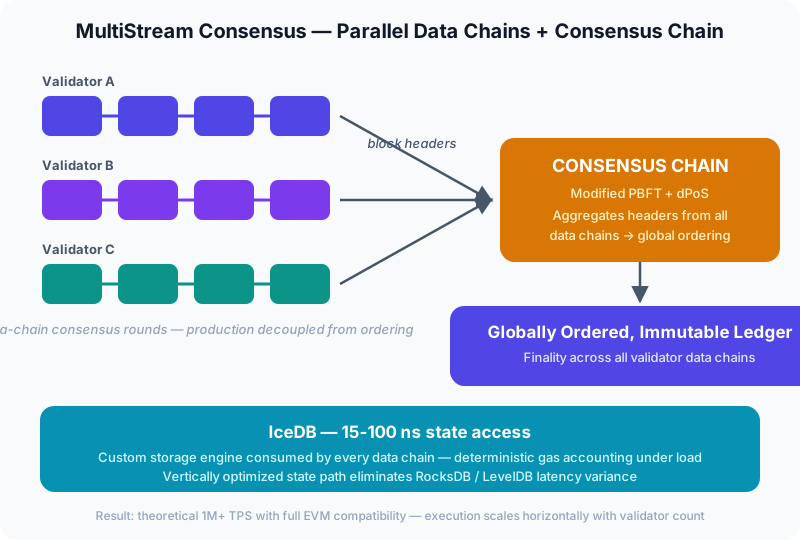
Somnia’s MultiStream Consensus is a partially synchronous Byzantine Fault Tolerant (BFT) protocol inspired by the Autobahn BFT framework. Its central insight: decouple data production from consensus. Under MultiStream, each validator operates its own independent blockchain—a data chain—allowing autonomous block production without consensus round-trips inside each chain. This eliminates the queue bottleneck that throttles single-stream BFT chains under load.
A separate Consensus Chain then aggregates block headers from every data chain, using a modified PBFT algorithm combined with delegated Proof of Stake (dPoS) to establish a single globally ordered, immutable record. The parallel-then-sequenced structure is what lets the network support millions of concurrent users in shared virtual environments without fee spikes or congestion.
Compiled Bytecode and Streaming Compression
Standard EVM clients run an interpreter loop—slow by design. Somnia compiles EVM bytecode directly into highly optimized native machine code on the fly, pushing execution speed toward hand-written C++ contracts on a single core.
To sustain the data throughput that native-speed execution generates, Somnia integrates streaming compression directly into its data-chain pipeline, combined with BLS signature aggregation. Together these techniques achieve extreme compression ratios, letting the network bypass bandwidth constraints that bottleneck conventional blockchains at high TPS.
IceDB: Eliminating Database I/O Bottlenecks
In high-throughput systems, the database is almost always the final bottleneck. Generic key-value stores like RocksDB or LevelDB introduce unpredictable read/write latencies under heavy load. Somnia’s response is IceDB, a custom storage engine vertically optimized for state access:
- Average read/write latency: 15–100 nanoseconds
- Deterministic gas accounting based on actual resource consumption
- Consistent performance under heavy concurrent load
By treating the database as a first-class architectural component rather than an off-the-shelf dependency, Somnia removes the most common source of latency variance in EVM-compatible chains.
Competitive Positioning
| Feature | Somnia | Monad | Solana | Sui |
|---|---|---|---|---|
| Theoretical Max TPS | 1,000,000+ | 10,000 | 65,000+ (Firedancer 1M+) | 120,000+ |
| Storage Engine | Custom IceDB | MonadDB | Account-based global state | Object-based (DAG) |
| Parallelization | Multithreaded + IceDB-optimized | Optimistic parallel execution | Parallel smart contracts | Parallel object execution |
| EVM Compatibility | Full (EVM+ with VOP) | Full bytecode | None (Rust/SVM) | None (Move/SuiVM) |
| Transaction Fee | Ultra-low (<$0.01, scales down) | Ultra-low | ~$0.00025 | Ultra-low (separate storage fee) |
For a comparable EVM L2 perspective, see our MegaETH real-time blockchain analysis, and for non-EVM contrast, the Sui Network economic architecture deep-dive.
Agentic L1: On-Chain LLMs and Reactive Smart Contracts
Beyond serving as a financial ledger, Somnia positions itself as an Agentic L1—designed to natively run decentralized computational agents on-chain, including deterministic LLM inference.
Deterministic On-Chain LLM Execution
Somnia Agents function as decentralized, sandboxed compute containers—analogous to AWS Lambda but with the auditability, security, and consensus of a blockchain. The breakthrough is the ability to run Large Language Models directly inside the validator network.
To make AI outputs deterministic (a hard requirement for consensus), Somnia’s on-chain LLMs operate with fixed random seeds and controlled temperature parameters. The same input always produces the exact same output across all validating nodes. When an Agent is invoked:
- Execution runs on a decentralized subcommittee of validators.
- The result is valid only when a majority of the subcommittee reaches consensus.
- A verifiable audit receipt is produced and recorded on-chain.
Agent Fee Structure and Developer Interface
Invoking a Somnia Agent requires a deposit in SOMI (mainnet) or STT (testnet). The deposit splits into two pools:
- Operations Reserve — funds gas refunds for runners, callback gas, and keeper fees.
- Agent Reward Pot — anything above the operations reserve is split equally among the elected subcommittee validators upon finalization. Leftover funds are refunded to the requester.
Critically, agent interaction uses an ABI-native schema—invoking an Agent is identical to calling a standard Solidity contract via ABI-encoded HTTP POST. Developers use familiar libraries like viem or ethers.js, with no new SDK to learn.
Reactive Smart Contracts and Data Streams
Somnia’s reactive architecture lets smart contracts automatically listen and respond to on-chain events in real time, eliminating external polling loops. Combined with custom Data Streams infrastructure, applications subscribe to live data feeds. This unlocks application patterns previously infeasible on EVM:
- Self-resolving prediction markets that settle the instant outcome data arrives.
- Autonomous evolving games where world state changes based on on-chain triggers.
- Reactive DeFi protocols that rebalance positions or adjust pricing in real time without keeper bots.
SOMI Tokenomics, Vesting, and Phased Governance
SOMI is the network’s economic primitive: it pays for gas, secures the network through staking, and routes governance authority.
Allocation and Vesting
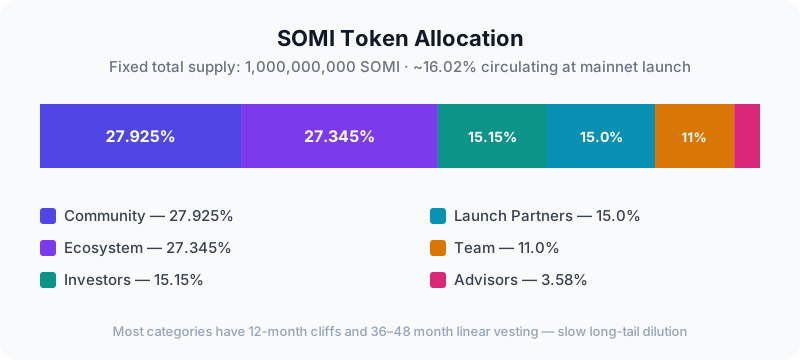
The total supply is capped at 1,000,000,000 SOMI with no future issuance. Allocation is distributed across six categories with multi-year vesting:
| Category | Allocation | Tokens | Vesting Schedule |
|---|---|---|---|
| Community | 27.925% | 279.25M | 10.945% at TGE; elevated unlocks months 1–2; then linear over 36 months |
| Ecosystem | 27.345% | 273.45M | 5.075% at TGE; linear over 48 months |
| Investors | 15.150% | 151.50M | 12-month cliff; linear over 36 months |
| Launch Partners | 15.000% | 150.00M | 12-month cliff; linear over 48 months |
| Team | 11.000% | 110.00M | 12-month cliff; linear over 48 months |
| Advisors | 3.580% | 35.80M | 12-month cliff; linear over 36 months |
At mainnet launch on September 2, 2025, only ~16.02% (160.2M SOMI) entered circulation—a deliberate dilution-control mechanism to stabilize early price discovery.
Dynamic Gas Pricing with Volume Discounts
Somnia inherits standard EVM gas mechanics but layers a step-function volume discount keyed to average hourly TPS, sharply lowering costs for high-throughput applications:
| Sustained TPS | Discount vs. Base | Cost of 21k-Gas Transaction |
|---|---|---|
| 0.0 | 0% | $0.00012 |
| 0.1 | 20% | $0.00009 |
| 1.0 | 40% | $0.00007 |
| 10.0 | 60% | $0.00005 |
| 100.0 | 80% | $0.00002 |
| ≥400.0 | 90% | $0.00001 |
Base transaction cost is fixed at 21,000 gas. Additionally, Somnia offers temporary storage pricing (SSTORE) with up to a 90% discount for short-lived state (e.g., 1-hour duration), discouraging state bloat while keeping ephemeral application data cheap.
To stabilize fees against load swings, validators vote on the base fee every second (every 10 blocks) based on actual execution times. If a block takes over 95ms to execute, validators can double the base fee; under 95ms, they can halve it—floored at the 21k-gas minimum.
Deflationary Mechanism and Phased Governance
To anchor long-term token value, 50% of all gas fees are permanently burned, creating deflationary pressure proportional to network activity. The remaining 50% flows to validators by staked weight as a long-term security incentive.
Governance unfolds across three explicit phases:
- Phase 1 (months 0–6) — Foundation-led, ensuring safe and stable mainnet operation and preventing interference from malicious actors at launch.
- Phase 2 (months 6–24) — Transitional, introducing progressive community and partner involvement in decision-making.
- Phase 3 (24+ months) — Full multi-parliament model granting validators, developers, and users decentralized governance authority.
Ecosystem Strategy: Grants, Incubators, and Flagship Titles
Backed by $270 million in combined capital across Improbable, MSquared, and VSF, Somnia has the treasury depth to fund ecosystem development at scale rather than rely solely on speculative volume.
Grant and Incubator Programs
- Dream Catalyst ($10M) — flagship program in partnership with Uprising Labs, supporting Web3 game studios with funding, tokenomics advisory, and go-to-market strategy.
- Dreamathon ($200K) — 8-week pilot incubator with Cracked Labs and the AI-driven Supafund platform; 20 grassroots teams build MVPs across DeFi, SocialFi, and InfoFi, with the top 10 finalists receiving up to $20,000 each.
- Blocktober — month-long educational program teaching creators to build 3D Unity levels.
- Security Grant ($100K) — funds professional smart-contract audits across ecosystem projects.
Flagship Ecosystem Titles
- Chunked — fully on-chain multiplayer sandbox built by Improbable on the MSquared platform.
- QRusader — mobile roguelite translating real-world QR codes into procedurally generated dungeons; uses Somnia’s Battle Records system to persist gameplay on-chain.
- Netherak Demons — dark-fantasy action RPG with fully-owned NFT demon characters.
- Variance — live-service anime roguelike RPG with a seasonal content model.
- Quills NFT — medieval NFT collection (3,000+ items, ~733,000 ETH historical valuation) that migrated to Somnia mainnet, paving the way for Quills: The Medieval War on the Epic Games Store.
Launch Airdrops
To bootstrap early adoption, Somnia executed a dual airdrop at mainnet:
- Community Airdrop (5%) — 4.33% to testnet users, 0.38% to creators, 0.1% to SomniYaps holders, 0.2% to Quills NFT holders; 20% unlocked immediately, remainder vesting over 60 days.
- Binance HODLer Airdrop (3%) — 30,000,000 SOMI to users staking BNB on Binance, rapidly decentralizing early holder distribution.
Market Performance, USDso, and Cross-Chain Liquidity
A mature ecosystem requires more than the native token—it needs stable settlement assets, deep liquidity, and frictionless bridging.
The Native USDso Stablecoin
Launched May 5, 2026 in partnership with Frax Finance using the frxUSD framework, USDso is over-collateralized at 102.38% by tokenized U.S. Treasuries and other secure real-world assets, with 1:1 minting from USDC.
The economic structure routes 90% of USDso’s reserve yield back into Somnia’s DeFi protocols as liquidity incentives, with the remaining 10% retained in an insurance fund. This model powers capital-efficient on-chain Central Limit Order Books (CLOBs) like dreamDEX, which operates with a zero-fee structure optimized for AI-driven trading systems.
LI.FI Cross-Chain Integration
On May 25, 2026, Somnia integrated LI.FI Protocol, enabling seamless asset swaps and bridges across more than 60 networks. This removes the typical onboarding friction that plagues new L1s and gives developers a single SDK for cross-chain UX.
Trading Performance and Exchange Liquidity
As of May 2026, SOMI trades near $0.172 after a volatile launch phase that peaked at $1.84. Current metrics:
| Metric | Value |
|---|---|
| Price | ~$0.172 |
| Circulating Supply | 243,235,907 SOMI |
| Market Cap | ~$42M |
| Fully Diluted Valuation | ~$170M |
| Daily Volume | ~$25M |
| Launch Peak | $1.84 |
SOMI liquidity is broadly distributed across major venues, with HTX and Binance leading by spot volume:
| Exchange | Pair | Daily USD Volume |
|---|---|---|
| HTX | SOMI/USDT | $5.0M |
| Binance | SOMI/USDT | $3.8M |
| Upbit | SOMI/KRW | $3.56M |
| Bybit | SOMI/USDT | $1.64M |
| SuperEx | SOMI/USDT | $1.45M |
| BitMart | SOMI/USDT | $1.45M |
| Bithumb | SOMI/KRW | $670K |
Market access broadened further when Coinbase launched SOMI perpetual contracts in October 2025, alongside Upbit’s KRW/BTC/USDT pairs. Traders evaluating exposure can compare access across leading global exchanges.
Critical Risk Assessment
Strong technical foundations do not exempt Somnia from structural risks, and the next 12 months will determine whether the network’s design choices scale gracefully.
Validator centralization. Running an active validator requires a stake of 5,000,000 SOMI—approximately $850,000 at current prices. Institutional participation (Google Cloud is listed among operators) ensures hardware uptime, but a stake floor this high meaningfully concentrates the validator set. The phased governance roadmap mitigates this only if execution stays on schedule.
Governance transition risk. The shift from Foundation-led control (months 0–6) to a community-driven multi-parliament model (24+ months) is a known choke point. Any delay—technical, political, or stakeholder-driven—erodes the trust premium attached to the Web3 narrative.
Intense L1 competition. Somnia enters a crowded field. Solana, Aptos, Sui, and EVM-compatible competitors like Monad and MegaETH already command developer mindshare and network effects. Technical superiority on paper does not guarantee application traction.
Token unlock pressure. With only ~16% circulating at TGE and large allocations (community, ecosystem, partners) unlocking over 36–48 months, SOMI faces ongoing dilution. The 50% gas-fee burn mechanism only meaningfully offsets dilution at sustained high transaction volume—a chicken-and-egg dependency on real adoption.
Because high-velocity DeFi and on-chain agent activity multiply smart-contract surface area, holders of meaningful SOMI positions should pair on-chain activity with offline storage via a hardware cold wallet to insulate keys from the inevitable exploit and exchange risks that accompany emerging ecosystems.
Conclusion: Full-Stack Bet on Real-Time Web3
Somnia is not merely another high-throughput EVM chain—it is a simultaneous redesign of consensus, execution, and storage wrapped in a genuinely novel primitive: deterministic on-chain LLMs running natively in the validator set. By decoupling data production from consensus through MultiStream, compiling EVM bytecode to native code, and replacing generic key-value stores with IceDB, the network removes the bottlenecks that have capped earlier EVM-compatible L1s.
Three takeaways frame the next 12 months. First, the architectural ambition is real—the combination of MultiStream, compiled bytecode, IceDB, and Somnia Agents has no direct precedent. Second, capital is not the constraint: $270 million in committed backing, a deflationary token model, USDso liquidity, and a deep grant program give the foundation room to operate. Third, execution and decentralization risk are the binding constraints—the validator-stake floor, the phased governance handoff, and competition from Solana, Sui, and the new EVM L1 cohort will determine whether technical superiority translates into durable adoption.
For builders, Somnia opens application categories that previous EVM chains could not host: real-time on-chain games, autonomous agents with verifiable LLM inference, and reactive DeFi without keeper bots. For investors and analysts, the central question is not whether the architecture works—the testnet and early mainnet metrics suggest it does—but whether the team can convert ecosystem grants into self-sustaining consumer applications before competing L1s close the performance gap.
Learn More
For comparison with a real-time EVM Layer 2 approach to similar performance goals, see our MegaETH analysis. For traders evaluating exposure across emerging L1 ecosystems, our crypto exchange comparison guide breaks down liquidity, fees, and access across leading platforms.
Key Sources
This analysis synthesizes protocol documentation, market data, and partner announcements, including:
- Somnia Network — official site
- Somnia Docs — protocol concepts and developer reference
- Somnia Agents — on-chain agent and LLM execution model
- Improbable — distributed systems heritage and metaverse strategy
- Frax Finance — frxUSD framework underpinning USDso
- LI.FI Protocol — cross-chain liquidity routing
Disclaimer: This analysis is provided for educational and informational purposes only. It does not constitute financial, investment, tax, or legal advice. Cryptocurrency and emerging Layer 1 blockchains carry substantial risk, including the potential loss of principal, and early-stage networks face heightened technical, liquidity, and governance uncertainty. Token prices, valuations, and ecosystem metrics referenced reflect specific dates and can change rapidly. Always conduct your own due diligence and consult licensed professionals before making investment decisions.